
Conference // Concrete and the Making of Eastern Europe: From Interimperial Networks to the International Socialist Division of Labor
Termindetails
Wann
27.01.2027 um 19:30
Art
Wo


Program >>
Program and Abstracts (PDF) >>
Participation >>
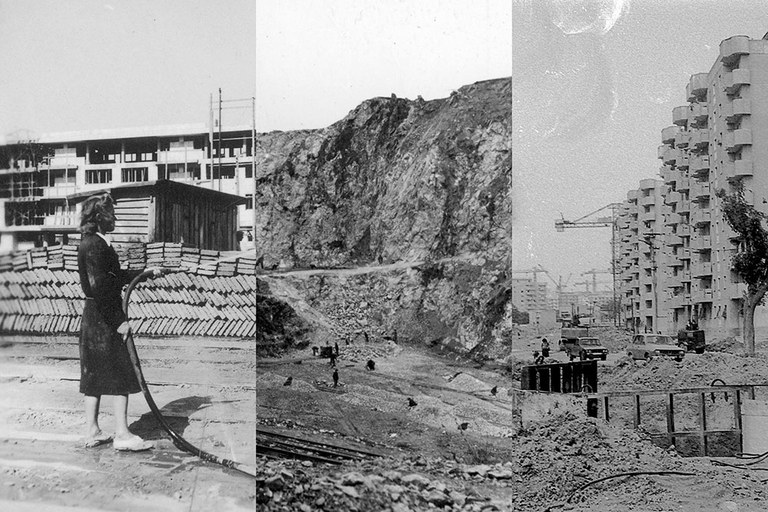
From apartment blocks to hydroelectric dams, concrete has come to define the aesthetics and materiality of modernity. In Eastern Europe, the material is invariably inflected by the memory of state socialism. Nostalgically cherished or reviled, ubiquitous large-panel apartment blocks function as a symbolic shorthand for the equalizing ambitions ascribed to state socialism. In recent years, the divisive aesthetics of concrete has been complicated by a growing awareness of the material’s environmental impacts, ranging from the CO2 emissions inherent in the production of cement to the destruction of topsoil, river and seabed habitats caused by aggregate extraction.
Engaging with these debates, the conference “Concrete and the Making of Eastern Europe” unpacks the aesthetics, politics, and ecologies of concrete architecture in the region throughout the twentieth century. The event brings together an international group of scholars who deploy the methods of architectural, political, economic, and environmental history to interrogate concrete as an ambivalent material of interconnection linking local and global scales, technology and nature, construction and destruction.
This event is organized by the "Environment and Ecology" Research Group at the Zentralinstitut für Kunstgeschichte, Munich.
PROGRAMME
DAY 1, JANUARY 26, 2027
14:00 | Introduction
14:15–15:45 | Panel I: Extraction
Lilija Wedel, Georg-August Universität Göttingen // Building the Oil City: Industrial Infrastructures, Construction Materials, and Extractive Landscapes in Imperial Baku
Paul B. Jaskot, Duke University // World War II, Forced Labor, and Cement: Building Capacity through Architectural Production and the German Construction Industry
Sofia Boldrini and Bianca Chescon, University of Campinas // CRUSP’s Concrete Grounds: Soviet Exchange and Extractive Chains in Brazil, 1961–1963
Chair: Monika Motylińska, Leibniz-Institut für Raumbezogene Sozialforschung
15:45–16:15 | Break
16:15–18:15 | Panel II: Development
Olga Konovalova, ETH Zurich // Reinforced Concrete and Industrial Development: The AEG Factory by Maillart&Co in Kharkiv, 1916
Jan Zofka, GWZO Leipzig // Cement Industry Equipment for the Bloc and Beyond: Polysius Dessau and its Transnational Connections in the Early Cold War Period
Jelica Jovanović, Technical University Vienna and Yichuan Chen, University College London // Freeing the Concrete Knowledge: Flows of Prestressed Concrete Technologies between Yugoslavia and China
Michael Brinley, Princeton University // Demos and the DSK: The Sverdlovsk Housing Construction Factory and the Politics of Late Soviet Concrete
Chair: Nikolay Erofeev, Freie Universität Berlin
DAY 2, JANUARY 27, 2027
14:00–16:00 | Panel III: Material Politics
Ecem Saricayir, California College of the Arts // Inconcrete Modernism: Le Corbusier, the Soviet Union, and the Caucasus
Vendula Hnídková, Czech Academy of Sciences // The Concrete Fortress: Materializing Development in Interwar Czechoslovakia
Jérôme Bazin, Paris-East Créteil University // Domesticating Concrete in the Countryside: The Material Ambiguity of Concrete
Kristóf Nagy, Princeton University // Loving Concrete – Hating Concrete: The Paradoxes of Building Materials among Nationalist Architects in Socialist Hungary
Chair: Christian Fuhrmeister, Zentralinstitut für Kunstgeschichte, Munich
16:00–16:15 | Break
16:15–17:45 | Panel IV: Waste
Katherine Zubovich, State University of New York, University at Buffalo // ‘The Wind Scatters Grey Dust’: Cement Production, Movement, and Toxicity at Local and Soviet Scales
Oxana Gourinovitch, Berlin // Concern Wismut: Concrete and Waste in the Spatial Production of the Soviet-German Uranium Mining
Ksenia Litvinenko, Leibniz-Institut für Raumbezogene Sozialforschung // Moving Beyond Concrete? Material Experiments in Late-Soviet Portable Architecture for Resource Extraction
Chair: Adam Przywara, University of Basel
18:15–19:30 | Keynote lecture
Kim Förster, University of Manchester // The History of Cement: Economic Foundations, Cultural Transformations, and Material Continuities in Twentieth-Century Germany
___________
The conference will take place online via Zoom. Participation is free of charge. Join via Zoom >>
Please note that recording the event, in whole or in part, as well as taking screenshots, is not permitted. By participating, you agree to these terms of use.
Please note: the keynote lecture will take place in hybrid form (online and on-site).