
Lecture // Kim Förster: The History of Cement: Economic Foundations, Cultural Transformations, and Material Continuities in Twentieth-Century Germany
Termindetails
Wann
von 18:15 bis 19:30
Wo


Over the course of the twentieth century, cement became a quintessential modern building material and the predominant binding agent in both capitalist and socialist societies. Though its grey appearance may suggest neutrality, cement conceals a complex history shaped by economic, cultural, and ecological forces. In this keynote lecture, Kim Förster offers a new perspective on cement in Eastern and Western Europe through the lenses of environmental history, architectural humanities, and political ecology. Around 1900, German art history acknowledged cement production’s effect on the landscape, yet rarely considered cement plants a subject of study. From the interwar period onward, cement production came to represent far more than industrial infrastructure: it underpinned industrialization, modernization, and urbanization. The sector was at once an employer, supplier, and source of profit—as well as a symbol of progress. Examining actors including the Bauhaus Dessau, founded in 1926, and the Dessau-based machine manufacturer Polysius, then a global leader in cement plant engineering, the lecture explores the intersections of state, industry, and culture. Its primary focus is the postwar period, contrasting reconstruction and expansion in the cement and construction industries of the German Democratic Republic (GDR) and the Federal Republic of Germany (FRG). Key players include Dyckerhoff (Wiesbaden), Dywidag (Munich), and the VEB Zementkombinat (Dessau), as well as decentralized concrete plants. In both German states, prefabricated concrete components—made possible by standardization and rationalization—played a central role in housing construction and in roofing industrial facilities. 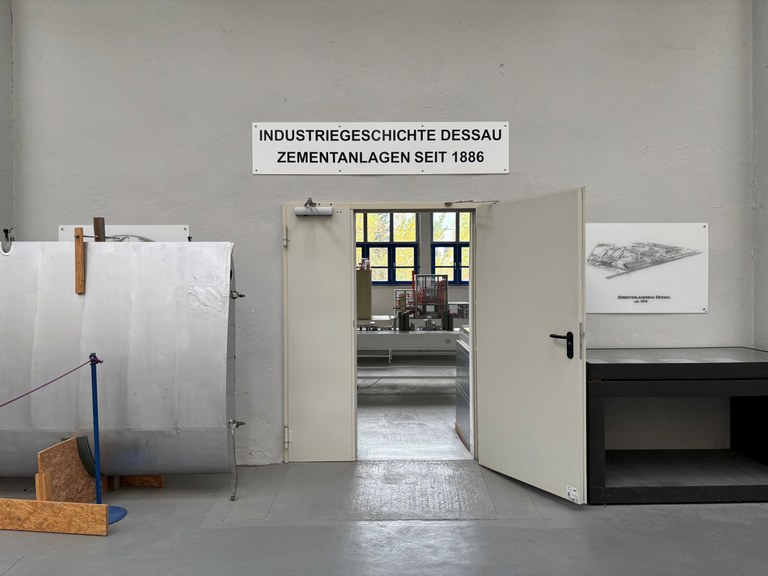 Drawing on archival research, the lecture traces continuities, competition, and cross-border knowledge transfers associated with the export of materials and entire cement plants. Finally, the lecture concludes by examining the transformations that followed 1989: initial skepticism toward international collaboration, the dissolution or acquisition of Eastern European production sites, and the ecological consequences of the multinational cement industry, illustrated by companies such as Heidelberg Materials. It invites audiences to reconsider architectural, urban, and landscape development, presenting cement as both a constructive force and a destructive legacy in both Eastern and Western Europe.
Kim Förster is an architectural historian, critic and curator, and Senior Lecturer in Architectural Studies at the University of Manchester. His work examines institutional politics, architectural knowledge and cultural production, and environmental, energy and material history. Previously, he was Associate Director of Research at the Canadian Centre for Architecture in Montréal. His books include Building Institution (2024) and Undisciplined Knowing (2022); he also edited the series Environmental Histories of Architecture (2022). His current research, teaching, exhibition, and publications explore the global history of cement, with a particular focus on cement modernity and culture.
[Caption: Technikmuseum "Hugo Junkers" Dessau. Photo by Kim Förster]
___________
The event will take place in a hybrid format. You can attend either in person or online via Zoom. Participation is free of charge.
Join via Zoom >>
Please note that recording the event, in whole or in part, as well as taking screenshots, is not permitted. By participating, you agree to these terms of use.