
Das Auge der Kamera: Kunst, Politik und Wahrnehmung in der amerikanischen Fotografie
Dorothea Langes 1936 entstandenes Porträt Migrant Mother gilt als eine der ikonischsten Fotografien der Zeit der Großen Depression in den USA. Das Bild verdichtet die Situation von Migrantinnen sowohl in der Darstellung ihrer prekären Lebensumstände als auch im Ausdruck ihrer Entschlossenheit und Widerstandskraft. Anlässlich des bevorstehenden 90. Jahrestags dieser berühmten Fotografie nimmt die Vortragsreihe diesen Moment zum Ausgangspunkt, um aus internationaler Perspektive die „practices of looking“ (Sturken/Cartwright) in der amerikanischen Fotokunst zu untersuchen.
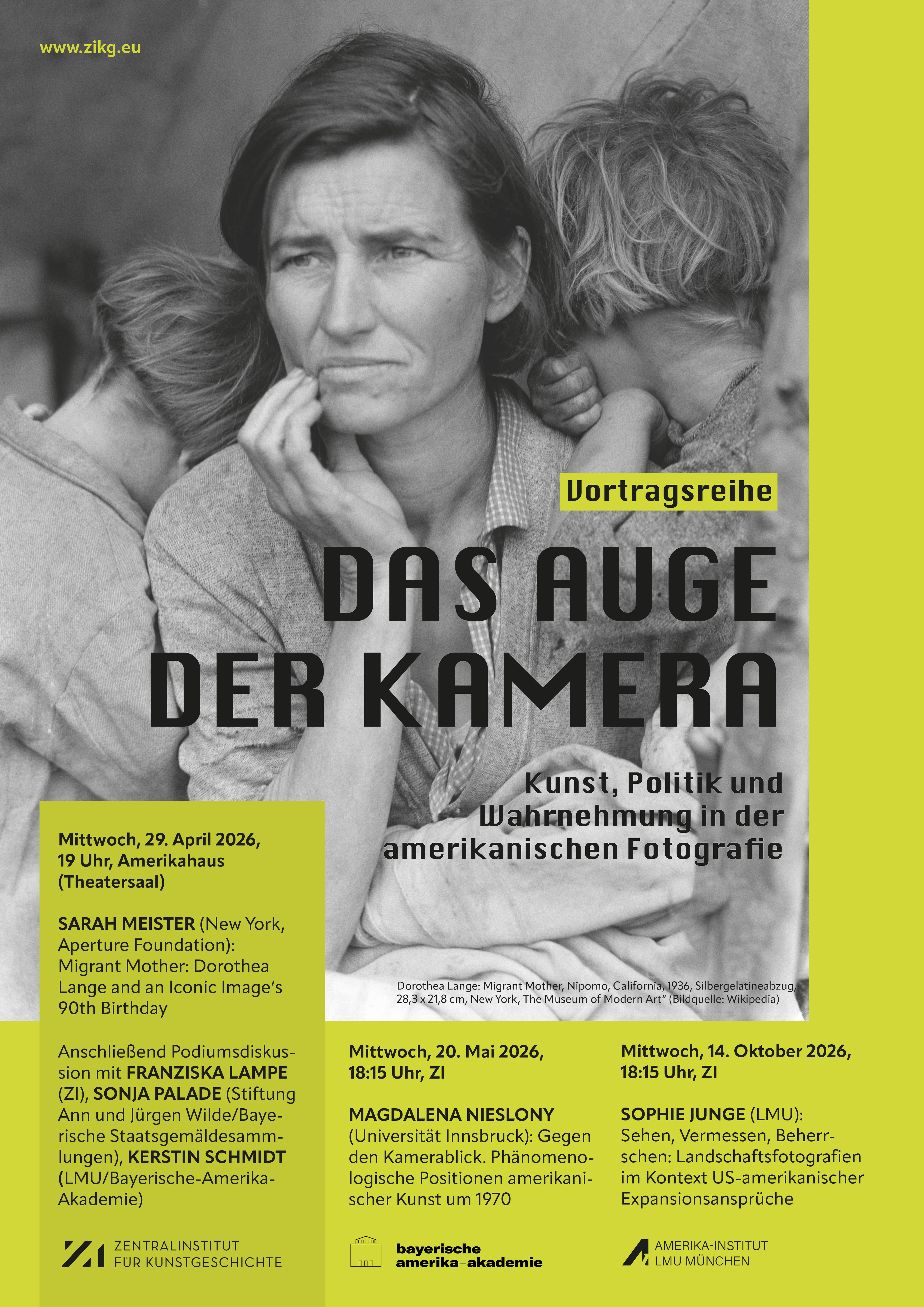 Ausgehend von Ariella Azoulays Konzept des „civil contract of photography“ richtet die Reihe den Blick auf die Beziehung zwischen Fotograf*in und Fotografierten ebenso wie auf die Rolle der Betrachter*innen, die in Akte des Sehens und Wahrnehmens, ja sogar der Entwerfens der Welt, in der sie leben, eingebunden sind. Fragen von Eigentum, Wahrnehmung sowie das oft spannungsreiche Verhältnis der Fotografie zu Staat und Politik fließen ebenfalls in die Diskussion ein. Die Betrachtung eines vielfältigen Spektrums fotografischer Arbeiten im Sinne von skopischen Regimen eröffnet die Möglichkeit, fotografische ‚Bildakte‘ und ihre visualisierten Objekte kritisch zu hinterfragen und neu zu bewerten – und damit die anhaltende Faszination wie auch die teils bis heute tradierte Annahme von der Wahrheitsfähigkeit der Fotografie in Frage zu stellen.
Die Vortragsreihe wird gemeinsam organisiert von drei Münchner Institutionen: dem Zentralinstitut für Kunstgeschichte, der Bayerischen Amerika-Akademie und dem Amerika-Institut der LMU | Vertreten durch Dominik Brabant, stellvertretender Direktor des Zentralinstituts für Kunstgeschichte, und Kerstin Schmidt, Professorin für nordamerikanische Literaturwissenschaft am Amerika-Institut der LMU München sowie Direktorin der Bayerischen Amerika-Akademie (BAA).
-
The Eye of the Camera: Art, Politics, and Perception in American Photography
Dorothea Lange’s 1936 portrait Migrant Mother has become a celebrated icon of the American Depression, visually capturing migrants’ situation both in terms of their dire living conditions and as an expression of their determination. We take the 90th birthday of this celebrated American photograph as our point of departure to investigate the “practices of looking” (Sturken/Cartwright) in American photographic art from an international perspective.
Following Ariella Azoulay’s “civil contract of photography,” the aim of this short lecture series is to shed light on the relationship between the photographer and the photographed as well as on the ways in which audiences are implicated in practices of looking at and perceiving, if not envisioning the world in which they live. Ideas of appropriation, perception, and photography’s often fraught relation to government and politics will feed into our discussion as well.
Viewing a diverse array of camera works as a scopic regime allows us to critically consider and reevaluate photography’s visual acts and visualized objects and thus potentially to challenge the persistent assumption – and the allure – of photography’s still powerful claim to truth.
This lecture series is jointly organized by Munich’s Central Institute of Art History (ZIKG), the Bavarian American Academy (BAA), and LMU’s Amerika Institut. | Represented by Dominik Brabant, Deputy Director of the Zentralinstitut für Kunstgeschichte, and Kerstin Schmidt, Professor of North American Literature at the Amerika-Institut of LMU Munich and Director of the Bavarian America Academy (BAA).
Lecture with Roundtable-Discussion // Sarah Meister - “Migrant Mother”: Dorothea Lange and an Iconic Image’s 90th Birthday
The evening with Sarah Meister launches the event series “The Eye of the Camera: Art, Politics, and Perception in American Photography,” which is jointly organized by the Bavarian American Academy (BAA), Zentralinstitut für Kunstgeschichte (ZI), and the Amerika Institut at LMU Munich.
Vortrag // Magdalena Nieslony: Gegen den Kamerablick. Phänomenologische Positionen amerikanischer Kunst um 1970
In der US-amerikanischen Kunst der 1960er und 1970er Jahre gewann die körperliche Präsenz der Werke an Bedeutung: KünstlerInnen wie Nancy Holt oder Richard Serra konzipierten Rauminstallationen und Land Art Projekte, die mit dem ganzen Körper erfahren werden sollten und diese Erfahrung zum eigentlichen Zweck machten. Die KünstlerInnen selbst und die KunstkritikerInnen deuteten diese Arbeiten mithilfe der Phänomenologie, die der leiblichen Wahrnehmung einen hervorgehobenen epistemischen Wert zuspricht.
Vortrag // Sophie Junge: Sehen, Vermessen, Beherrschen: Landschaftsfotografien im Kontext US-amerikanischer Expansionsansprüche
Der Vortrag analysiert historische und gegenwärtige Landschaftsdarstellungen im Hinblick auf visuelle Kontinuitäten und ihre spezifischen Publikationszusammenhänge. Im Zentrum steht die Dialektik zwischen dem vermeintlich dokumentarischen Kamerablick und den territorialen Expansionsansprüchen der USA in kulturhistorischer Perspektive ebenso wie in der politischen Gegenwart.