
Vortrag // Susan Dackerman: The Paleontology of Print. Lithographic Limestone and the Nature of Reproducibility
Termindetails
Wann
von 18:15 bis 19:30
Wo


While southern Germany is not typically regarded as a region with a marine history, about 150 million years ago, at the end of the Jurassic period, saltwater lagoons with muddy carbonate bottoms covered what is now Bavaria. The silty salty water trapped local flora and fauna, and when the lagoons dried up, the sediment hardened into lithographic limestone, preserving the forms of over 500 different species of marine, land, and airborne animals deposited in it.
For centuries, the slabs with their fossils were excavated from quarries in the Altmühltal valley between Kehlheim, Eichstätt, and Solnhofen, for use as building materials. Around 1500, regional sculptors such as Hans Daucher turned from sandstone and marble to the native limestone because the characteristics of the stone suited precision carving.
Some of the bas reliefs made from the Solnhofen Plattenkalk, as it is known locally, are based on woodcuts made by the Nuremberg artist, Albrecht Dürer. Alongside the designs carved in the limestone are petrified specimens of plants and animals embedded in the stone. At the time, these fossilized “images” were presumed to have been made by Nature herself.
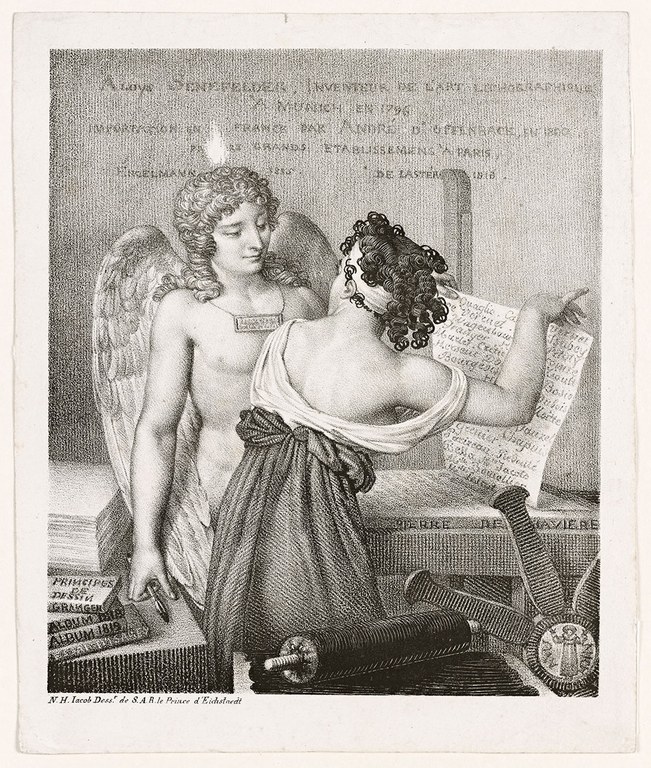
Notably, the fossil-laden stone sculptures often were used as templates to cast bronze copies, conceptually replicating the stone’s capacity to cast fossils. When nearly 300 years later, the stone’s generative potential again was exploited to make printed multiples known as lithographs, the origin of the fossil specimens embedded in the limestone was better understood.
Imagining the history of the production of early modern sculpted multiples and printed images alongside the history of paleontology enables us to see how Nature, and the contemporaneous historical theories that explicate it, have informed the work of artists, as well as shaped the history of print and replication.
Susan Dackerman (Ph.D., Bryn Mawr College) specializes in Early Modern Northern European art, with a focus on fifteenth- and sixteenth-century print culture. Her research investigates how printed images produce meaning and knowledge, especially in relationship to their materiality, manufacture, and physical presence. She currently is working on an ecological history of print matrices – woodblocks, copperplates, and lithographic limestones; questioning how the choice of their use was shaped by environmental conditions, as well as how the use of metal, wood, and stone was informed by contemporary conceptions of the natural world. Dackerman has held posts at the Baltimore Museum of Art, Harvard Art Museums, Getty Research Institute, and Stanford University. She currently teaches at UCLA.
This evening lecture is part of the workshop ‘Resources of Printmaking – Printmaking as Resource’.
______
PARTICIPATION:
Participation is free of charge. The event will be broadcast simultaneously via Zoom. You can join the Zoom meeting at the following link: https://us02web.zoom.us/meeting/register/nftNp7pVQcaktNfJlbyjTg. Recording the event or parts of the event, as well as taking screenshots, is not permitted. By participating, you accept these terms of use.
[Abbildung: Nicolas Henri Jacob (French, 1781–1871), The Genius of Lithography, from Senefelder, L’art de la lithographie (Munich, 1819), Getty Research Institute]