
Workshop // James A. van Dyke: Representing Shell: Modernism, Petroculture, and Politics in Interwar Germany
Termindetails
Wann
von 16:00 bis 17:00
Art
Wo


On 20 July 1930, tens of thousands of distracted readers looking through the Berliner Illustrirte Zeitung encountered a visually striking photomontage. This memorable image aimed to convey the scale of the infrastructure that the German subsidiary of the Royal Dutch Shell group, Rhenania-Ossag, had developed since the end of the First World War. A gas pump—a modern icon of the emerging visual and material cultures of automobility—rises dynamically above the clouds. If one built a single structure by stacking all the pumps that the company had installed since 1918, it would be hundreds of times taller than both the Cologne cathedral and the Eiffel tower. Two issues later, a second advertisement centered on another icon of petroculture, the oil storage tank. If the first photomontage had been about space, this one was about time. Shell products would always be everywhere, the images suggested. They were made by a modern company, global and national.
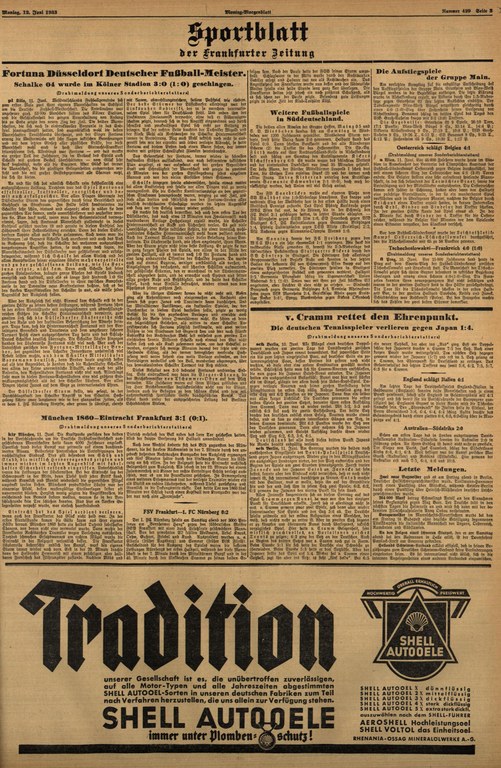
This workshop considers the poetics and politics of print advertisements for Shell lubricating oils and gasoline circulated in Germany between 1930 and 1933, assessing how the company attempted to respond to social transformation, economic crisis, political polarization, and the explosive success of radical nationalism. This work is part of a larger project that surveys the rapidly expanding visual culture and built environment of petromodernity between the world wars. Focusing on one important subsidiary of the oil multinational Royal Dutch Shell, the project gathers together a large corpus, ranging from photographic and traditionally illustrated advertisements to live-action and animated promotional films and architectural designs for office buildings and workers’ housing. Employing both the theoretical foundations and scholarly methods of the social history of art and those of contemporary ecocritical work on petroculture, the design of the project and its argument are relational. These fetishistic images were produced not only to elicit desire and to generate profit. They were part of an effort seductively to discipline labor. They constituted a defensive response to the counter-imagery produced by critics of the multi-national oil industry from across the political and ideological spectrum, from the satirical portraits and genre scenes of John Heartfield and Lea Grundig on the left, through Heimatschutz photography, to the visions of autarky championed by the National Socialists.
James A. van Dyke is Associate Professor of Art History at the University of Missouri and currently a Charles Haimoff Fellow in German Studies at the American Academy in Berlin. His research has been published in Art History, New German Critique, Oxford Art Journal, Oxford German Studies, Kunstchronik and Die Zeitschrift für Kunstgeschichte. James’ most recent book is Otto Dix in Detail: Painting and Precarity in the Field of Weimar Culture (University of Chicago Press, 2026).
____
PARTICIPATION: Participation is free of charge.
The event will be broadcast simultaneously via Zoom. You can join the Zoom meeting at the following link:
https://us02web.zoom.us/meeting/register/DIgrh2q_SICN_fE8gKod_g. Recording the event—or any parts thereof—as well as taking screenshots is not permitted. By participating, you accept these terms of use.