
David Sadighian // Beaux-Arts Worldbuilding: Andrew Carnegie’s Empire of Architecture
How can architecture function as an instrument of international order? To what extent do design methods, spatial forms, and building practices construct the limits of political possibility? My project investigates these and other questions through a global history of the circulation of architectural composition as taught at the Paris École des Beaux-Arts during the age of imperialism, c.1870-1940. At the Zentralinstitut für Kunstgeschichte, I am expanding the scope of my doctoral dissertation (Harvard University, completed May 2023), which examined how Beaux-Arts composition—a scalable design method based on aesthetic principles of symmetry, hierarchy, and monumentality—traveled along transnational networks of formal and informal empire, featuring case studies of buildings, cities, and landscapes in France, colonial Algeria, Brazil, Argentina, the U.S., the Hague, and beyond. 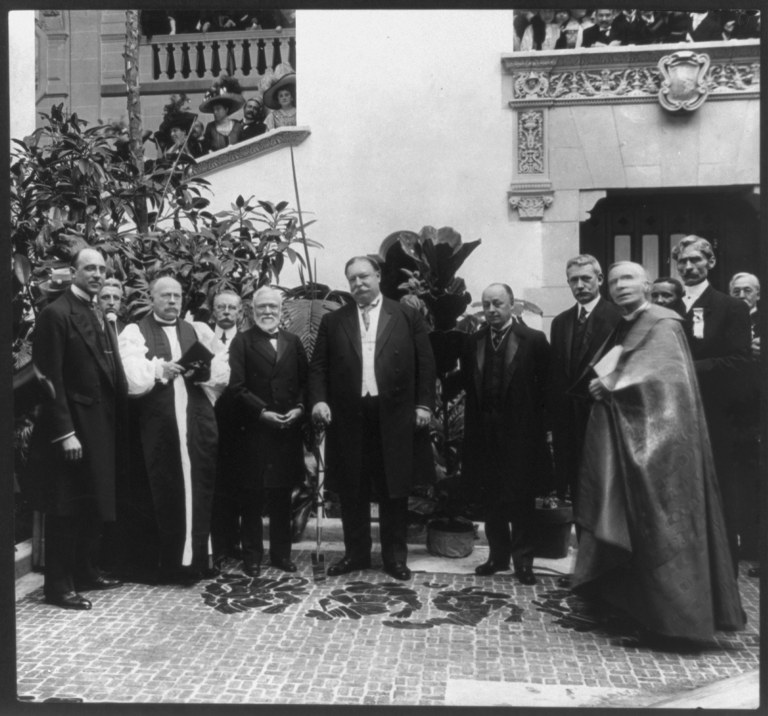
In Munich, I am deepening this investigation by writing two new chapters for a book manuscript based on my dissertation. The first of these two new chapters will be the subject of my ZI workshop: Examining the architectural philanthropy of Scottish American steel magnate Andrew Carnegie, this workshop asks how, for the Gilded Age industrialist, architecture functioned not merely as a symbol of elite culture but rather as a structural agent for organizing liberal international order. Carnegie provided the funds for a wide range of buildings during his lifetime, from a vast network of public libraries around the world to the monumental headquarters for new international organizations. Moreover, during the period in question (c.1900-1919), many of these projects were designed using methods of Beaux-Arts composition to naturalize ideas of social progress and civilizational authority. In this sense, Carnegie’s “empire of architecture” effectively mediated tensions between pacificism and imperial realpolitik. While rhetorically opposed to imperialism, Carnegie used architectural patronage to pursue alternative modes of domination—consistent with his belief in Social Darwinism. My presentation will situate Carnegie’s building projects within competing early twentieth-century models of world order, arguing that these architectural experiments helped shape enduring forms of corporate and institutional governance that continue to structure geopolitics today.
[Caption: “Andrew Carnegie, William Howard Taft, Elihu Root and Cardinal Gibbons, with others posed in Pan American Union Building, Washington, D.C.,” 26 April 1910, Photographic Print, Library of Congress Prints and Photographs Division Washington, D.C., Reproduction Number LC-USZ62-59174. URL: https://www.loc.gov/pictures/item/2005694646/]