
The Maiestas Domini with apostles in mural painting from the Romanesque period to the 15th century. Ways of transfer of an iconographic scheme of Cappadocian origin to Lombardy and Catalonia
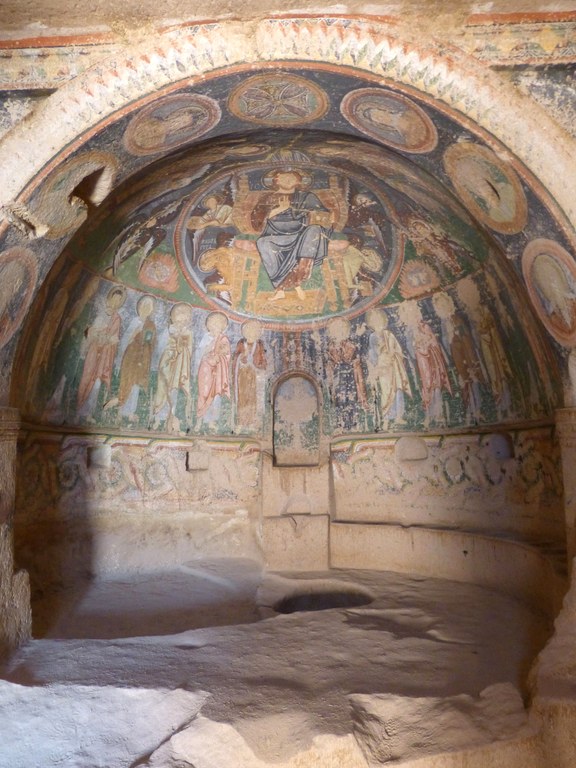 Since the 1930s, several scholars have noted stylistic and iconographic similarities between the mural paintings in Lombard and Catalan churches during the Romanesque period. These similarities have been attributed to the now controversial figure of the 'Master of Pedret' and are thought to reflect artistic exchanges between the two regions. Yves Christe, who had identified a Lombard distinctive feature in the depiction of the Maiestas Domini, characterized by a specific arrangement of the Animals around the Sitting Figure, with a systematic inversion of the lion and the ox compared to the typology most frequently encountered and advocated by Guillaume Durand in the Rationale divinorum officiorum, noted that this Lombard feature (absent from other regions of Italy) was also found in several Catalan churches. As in Lombardy, these particular Maiestas Domini are generally found in the apse conch of Catalan churches and surmount a depiction of an apostolic college in the middle register of the apse. This combination of Maiestas Domini and the apostolic college in the apse program appeared in Lombardy around the turn of the millennium and then spread rapidly to the Pyrenees and Catalonia between the 11th and 13th centuries. Long-lasting in Northern Italy, it subsequently spread widely throughout Central Europe, reflecting complex and enduring artistic exchanges. Looking at the bigger picture, it seems that this Lombard iconographic program may have derived from an Eastern model: that of the 10th-century rupestrian churches of Cappadocia.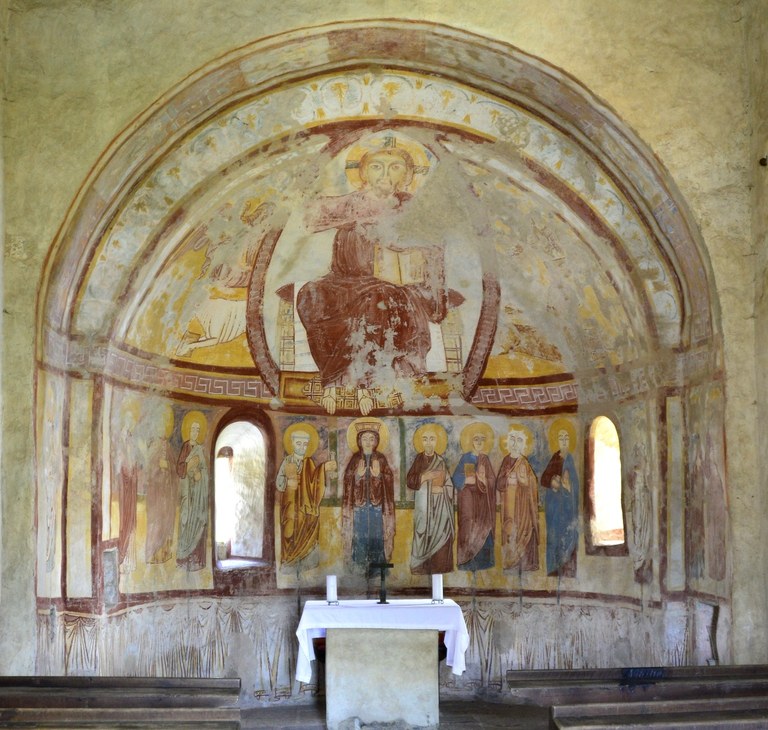
Building on this observation, the aim of this project is to investigate the origins of the Cappadocian apse program and how it may have spread to Lombardy and, subsequently, to Catalonia. Going beyond a simple historiographical review, the aim is to establish a more precise chronology concerning these transfers from East to West. The research will focus particularly on a group of Italian Romanesque paintings identified since the studies on the “Master of Pedret,” as well as on buildings in Central Europe catalogued by Vasile Drăgut in the 1960s, which may shed light on the stages of this diffusion. By studying the development of this iconographic program over a long period of time, between the 11th and 15th centuries, I would also like to underline the pivotal role of Lombardy (and the southern cantons of Switzerland) in its propagation and evolution — in Catalonia as well as in Central Europe —throughout this period. Indeed, while the examples from Transylvania and Central Europe cited by Vasile Drăgut for the 11th century could be used to trace a route from Cappadocia to Lombardy, the later examples of the persistence of this iconographic program in these same regions in the 14th and 15th centuries, and the style of the paintings, seem rather to indicate the opposite movement , and the clear and lasting influence of Italian Trecento artists throughout rural Central Europe.
[Caption: Fig. 1. Haçli Kilise, Cappadocia, Turkey- © By Ji-Elle - Own work, CC BY-SA 3.0httpscommons.wikimedia.orgwindex.phpcurid=25951524 | Fig. 2. San Vigilio, Rovio, Ticino, Switzerland - © By Cassinam - Own work, CC BY-SA 3.0https://commons.wikimedia.org/w/index.php?curid=21837548