
Workshop // Julian Volz: Mural Practices in North Africa's Alternative Modernity
Termindetails
Wann
von 12:00 bis 13:00
Wo


In this workshop, I will present my current research project, which focuses on modernist murals created between the 1930s and the 1970s in different North African countries.
The project takes as its starting point the observation that frescoes, mural painting, and other mural practices played a prominent role in the discussions and practices of modernist artists in Algeria, Egypt, Morocco, and Tunisia following their countries' independence. Particular emphasis was often placed on the specific qualities of mural painting: its resistance to the art market and thus to commodification, its frequent location in public spaces, and its predominantly collective character. In this sense, it becomes tangible what Stefan Germer meant when he described mural painting as a "utopian genre" in his monograph Historizität und Autonomie (1988), in reference to nineteenth-century French frescoes. Furthermore, if Christian Kravagna’s concept of the Transmodern (2022) refers to alternative forms of modernity that emerge through processes of transcultural exchange and that transcend established forms and media of artistic modernism, then the mural practices of many North African artists can be understood as a transgressive procedure rooted in the Transmodern.
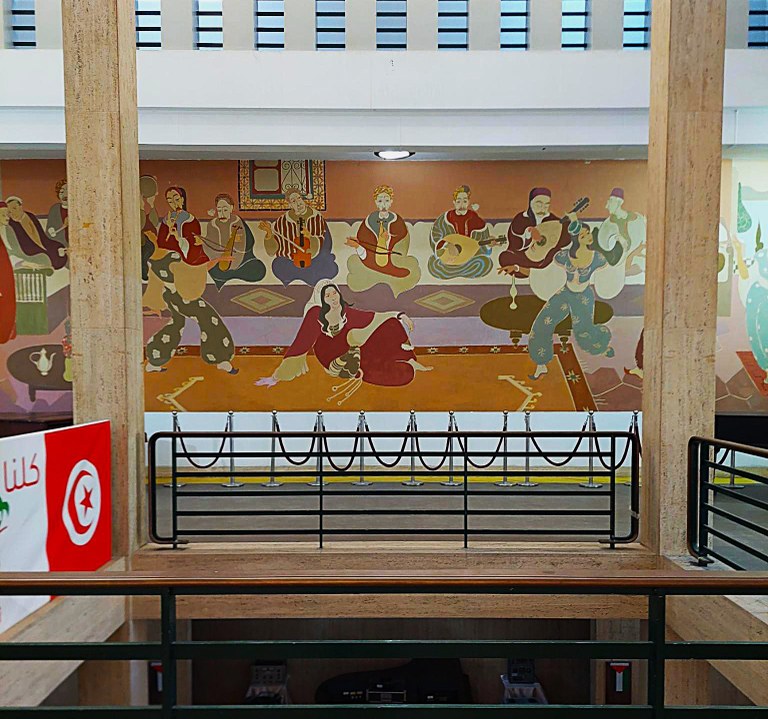 These recurring and emphatic references to mural painting by modernist artists from North Africa form the starting point of my research project. I ask why the mural held such appeal for the artists discussed in this project and how the practice of mural painting enabled them to develop alternative forms of modernity. My working hypothesis is that murals reveal particularly clearly the character of an alternative modernity in North Africa, which extends beyond the mere adaptation of a modern visual language to a local context. In this perspective, the mural becomes a site of experimentation where new ways of positioning art within the social sphere are tested. I will explore these questions through a series of case studies, each focusing on a different aspect of these practices.
[Caption: Zoubeir Turki, Mural at the Headquarters of Radiodiffusion Télévision Tunisienne, 1962-63, Photo: Julian Volz (January 2025)]